| « Obama is awarded the Nobel Peace Prize | For the first time EVER: Obama might actually have TO apologize to America, not FOR America » |
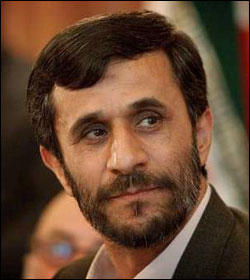
Mahmoud Ahmadinejad tells Obama, "The U.S. president made a big and historic mistake"

http://www.npr.org/templates/story/story.php?storyId=112777942
Iran's president hit back Saturday at President Barack Obama's accusation that his country had sought to hide its construction of a new nuclear site, arguing that Tehran reported the facility to the U.N. even earlier than required.
Obama and the leaders of France and Britain accused Iran of keeping the construction hidden from the world for years. The U.S. president said last month that Iran's actions "raised grave doubts" about its promise to use nuclear technology for peaceful purposes only.
ElBaradei, the head of the International Atomic Energy Agency, has also said Tehran was "on the wrong side of the law" over the new plant and should have revealed its plans as soon as it decided to build the facility.
President Mahmoud Ahmadinejad challenged that view in a speech Saturday, saying that Iran voluntarily revealed the facility to the IAEA in a letter on Sept. 21. He said that was one year earlier than necessary under the agency's rules.
"The U.S. president made a big and historic mistake," Iranian state TV quoted Ahmadinejad as saying. "Later it became clear that (his) information was wrong and that we had no secrecy."
White House spokesman Tom Vietor said the administration had no comment on Ahmadinejad's remarks.
Iranian officials argue that under IAEA safeguard rules, a member nation is required to inform the U.N. agency about the existence of a nuclear facility six months before introducing nuclear material into the machines. Iran says the new facility won't be operational for 18 months, and so it has not violated any IAEA requirements.
The IAEA has said that Iran is obliged under the Additional Protocol to the Nuclear Non-Proliferation Treaty to notify the organization when it begins to design a new nuclear facility.
Iran says it voluntarily implemented the Additional Protocol for 2 1/2 years as a confidence-building gesture, but its parliament passed legislation in 2007 forcing the government to end such cooperation after the country was referred to the U.N. Security Council for sanctions over its refusal to suspend uranium enrichment.
The IAEA has countered by saying that a government cannot unilaterally abandon such an agreement.
Does Iran have a nuclear program? Yes. Are they using it for peaceful endeavors? Probably not. Should Iran be forced to do what the U.N. tells it to do? No.
I hate to take the side of Iran here, but I think that there is quite a bit to consider here. The U.N. placed more stringent rules on Iran when it comes to reporting on their nuclear activity. So does Iran, as a sovereign nation, have the right to overrule the U.N. measure? I say yes. I think this sets a dangerous precedent; when the U.N. demands that a sovereign nation bend to its will.
Iran made a decision to stop going along with the U.N. protocol. This, because the protocol, led to Iran being turned over to the U.N. Security Council for sanctions. Sanctions were placed on Iran which caused economic problems, so the Iranian government decided to ignore the protocol. Makes sense to me.
Why is this a dangerous precedent?
US Treasury Secretary Tim Geithner shocked global markets by revealing that Washington is "quite open" to Chinese proposals for the gradual development of a global reserve currency run by the International Monetary Fund.
"The mere fact that the US Treasury Secretary is even entertaining thoughts that the dollar may cease being the anchor of the global monetary system has caused consternation," he said.
Mr Geithner later qualified his remarks, insisting that the dollar would remain the "world's dominant reserve currency ... for a long period of time" but the seeds of doubt have been sown.
The value of the dollar could be controlled --entirely by outside forces.
Other than the fact that the United States Dollar, currently, is the unit of world trade; what is there to keep the U.N. from placing sanctions against the United States?
The U.N. is not exactly filled with U.S. friendly countries if you remember. Polling shows that most Europeans would like to see a weaker United States, or at least a United States with less influence. The vast majority of votes in the U.N. are votes against the United States.
Just something to think about...
Note: You DO NOT need to register to leave a comment.
No feedback yet
 Comment feed for this post
Leave a comment