United States and Russia "Reset"

http://news.bbc.co.uk/2/hi/europe/7977031.stm
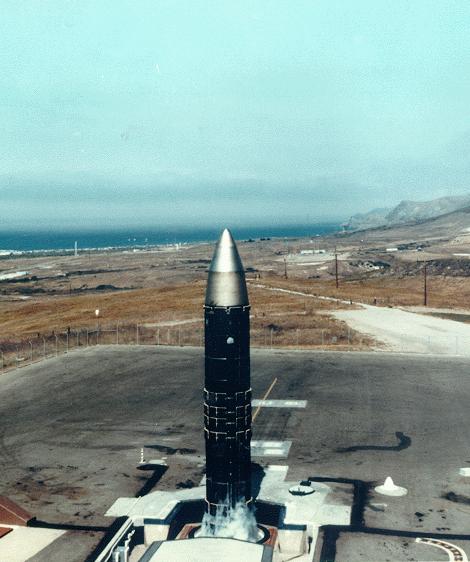
The current aim, reached in an agreement between Presidents George W Bush and Putin in Moscow in 2002 (and known as the Strategic Offensive Reductions Treaty or Sort) is to cut deployed warheads to between 1,700 and 2,200 on each side by 2012.
The new aim is to get an agreement to take those numbers much lower. It will still give them both the power to destroy each other several times over.
And why by December? Because that is when a previous treaty known as Start (Strategic Arms Reduction Treaty) runs out. Start made dramatic reductions in nuclear forces of some 80% but the key point at this moment is that contains binding agreements on verification and when the treaty runs out so do those commitments. They will have to be renewed if arms control is to be under proper monitoring.
That creates a timetable and an opportunity which both leaders have seized.
"The treaty needs political strengthening," said Mark Fitzpatrick. "It is under siege. The last review conference in 2005 was a failure and non nuclear-armed states are losing faith that the nuclear states are fulfilling their side of the bargain."
However, the reality is that the nuclear-armed states might disarm partially but will not disarm completely.
They are all in the process of modernizing their forces which will reduce them in numbers - but not eliminate them. A nuclear weapons-free world remains pie in the sky because there are - and will be - missiles in the sky instead.
So the United States and Russia are going to push the "Reset Button". No - not the misworded one that Hillary presented to the Russian foreign minister, but a metaphorical one.
The idea that either the United States or Russia are going to reduce their arsenal are ridiculous. Neither the U.S. or Russia are likely to actually use nuclear weapons on their enemy. Having a strong conventional weapons stockpile prevents the direct need for nuclear weapons. I find it interesting that the majority of countries that seem the most worried about a U.S. or Russian stockpile, are those most likely to actually use them.
A dating scenario can be used here to illustrate my point. Relationships require a lot of responsibility. You have to look out for two people, not just yourself. People who suspect the worst are often those who contemplate the worst. Sometimes you have a woman or a man that is constantly worried that their partner is going to cheat. This means that the person questioning the their partners motives constantly has cheating on the brain. This doesn't mean that they have, or will cheat, but that cheating in some form or another is occupying their thought process.
Gun control advocates often follow the same path. Those most afraid of firearms generally tend to be those who know the least, or do not trust themselves with that kind of power.
I think this is similar to the concerns of countries which seem worried about the number of weapons massed by the U.S. and Russia.
The truth is that both countries are already in the midst of reducing the number of nuclear weapons. They don't need as many now as they used to. With the implementation of MIRV technology (Multiple Independent Reentry Vehicle). each missile consists of multiple warheads. So a reduction in the number of deployment vehicles doesn't really matter when one vehicle can disperse a large number of warheads.
This action by the U.S. and Russia is just an exercise to pacify those who do not understand the issue.
--> My two cents...
Another point to consider: with Iran on the way to having a nuclear weapon and many rogue nations already having nuclear weapons, the U.S. and Russia would both be fools to let their defenses down now. If any country can be trusted with nuclear weapons, it's the U.S. and Russia.
Note: You DO NOT need to register to leave a comment.
Governmentium
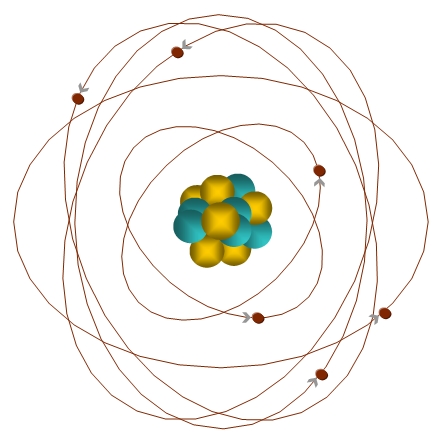
Lawrence Livermore Laboratories has discovered the heaviest element yet known to science.
The new element, Governmentium (Gv), has one neutron, 25 assistant neutrons, 88 deputy neutrons, and 198 assistant deputy neutrons, giving it an atomic mass of 312.
These 312 particles are held together by forces called morons, which are surrounded by vast quantities of lepton-like particles called peons.
Since Governmentium has no electrons, it is inert; however, it can be detected, because it impedes every reaction with which it comes into contact. A tiny amount of Governmentium can cause a reaction that would normally take less than a second, to take from 4 days to 4 years to complete.
Governmentium has a normal half-life of 2 - 6 years. It does not decay, but instead undergoes a reorganization in which a portion of the assistant neutrons and deputy neutrons exchange places.
In fact, Governmentium’s mass will actually increase over time, since each reorganization will cause more morons to become neutrons, forming isodopes.
This characteristic of morons promotion leads some scientists to believe that Governmentium is formed whenever morons reach a critical concentration. This hypothetical quantity is referred to as critical morass.
When catalysed with money, Governmentium becomes Administratium, an element that radiates just as much energy as Governmentium since it has half as many peons but twice as many morons.
Source: DaveRamsey.com
* Dave Ramsey did not write this. It has been circulating around the web for some time but seems more fitting than ever right now.
Note: You DO NOT need to register to leave a comment.
When it comes to GM and Chrysler, I can tell the future!
I called this one in February.
Take a read, tell me where I was wrong.
http://winduprubberfinger.com/blog1.php/2009/02/16/obama-creating-lstrikegauto-industryl-st
Remember the government doesn't own GM. Funny how the Obama calls for the head of GM and gets it - on a silver platter no less.
http://www.foxnews.com/politics/first100days/2009/03/30/obama-auto/
President Obama said Monday his administration has "no intention" of running General Motors, even as the White House demanded the resignation of the automaker's CEO and called for a "better business plan" before considering lending more government money to bail out the company.
Obama said the companies and the government might have to consider "using our bankruptcy code" to help the companies restructure more efficiently. He said any such action would take place "with the backing of the U.S. government."
Oh and, "with the backing of the U.S. government" means the government will be calling the shots. Sort of like when they called for the firing of GM's CEO.
Note: You DO NOT have to register to leave a comment.
Obama’s Second Prime Time Speech…
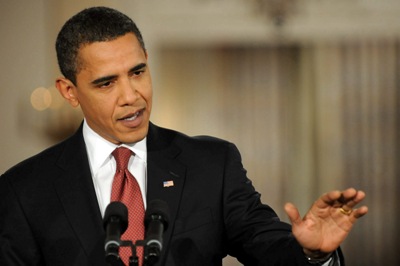
One of the most important parts of the speech was MISSED by every news outlet that I know of…
Obama:
I've said that we've got to have a serious energy policy that frees ourselves from dependence on foreign oil and makes clean energy the profitable kind of energy."
In this statement Obama admits that clean energy is NOT CURRENTLY PROFITABLE.
Does this mean that the Cap-and-Trade initiative is going to cause conventional energy prices to go up? The answer is YES Cap-and-Trade will cause conventional energy prices to spike at a ridiculous rate. It's like cigarettes, you tax it out of existence. It's o.k. though, now cigar prices are competitive with cigarette prices. The tax on cigarettes has not decreased the number of smokers, it will just curb what they are smoking. When it comes to power; people don't have the option to quit, we just have to pay higher energy prices. I thought Obama was looking out for the little guy here.
There are a few other things that most people heard, but didn't notice. One of the most interesting things I noticed was Obama’s use of the word SPEND. You will notice that SPEND is used as a negative term. While INVEST is used as a positive term.
Here are some of the examples of Obama’s use of the word SPEND.
Obama:
But given the problems that the financial bailout program has had so far -- banks not wanting to talk about how they're spending the money, the AIG bonuses that you mentioned -- why do you think the public should sign on for another new sweeping authority for the government to take over companies, essentially?
And -- and so what we're trying to emphasize is, let's make sure that we're making the investments that we need to grow to meet those growth targets, at the same time we're still reducing the deficit by a couple of trillion dollars, we are cutting out wasteful spending in areas like Medicare, we're changing procurement practices when it comes to the Pentagon budget, we are looking at social service programs and education programs that don't work and eliminate them.
Now observe Obama’s use of the word INVEST.
Obama:
It's with a budget that leads to broad economic growth by moving from an era of borrow and spend to one where we save and invest.
We invest in reform that will bring down the cost of health care for families, businesses and our government.
But it is -- it is going to be an impossible task for us to balance our budget if we're not taking on rising health care costs, and it's going to be an impossible task to balance our budget or even approximate it if we are not boosting our growth rates. And -- and that's why our budget focuses on the investments we need to make that happen.
And so what we've said is, look, let's invest in health information technologies.
See the difference? The truth, on the other hand, is the only way for any government to “invest” is to spend money. Funny how that works, isn’t it? We are currently borrowing and spending. Show me where the government is saving anything!
Note: You DO NOT have to register to leave a comment.
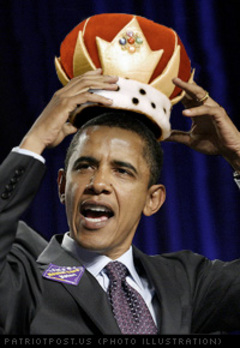
Obama needs to be CROWNED!
http://www.washingtonpost.com/wp-dyn/content/article/2009/03/24/AR2009032401310.html?hpid=topnews
"The issue of excessive compensation extends beyond AIG and requires reform of the system of incentives and compensation in the financial sector," Geithner said.
http://www.cnn.com/2009/POLITICS/03/24/geithner.powers/index.html
"To achieve that goal, the administration and Congress have to work together to enact comprehensive regulatory reform and eliminate gaps in supervision. All institutions and markets that could pose systemic risk will be subject to strong oversight, including appropriate constraints on risk-taking."
The Obama administration will ask Congress to give the Treasury secretary unprecedented powers to initiate the seizure of non-bank financial companies, such as large insurers, investment firms and hedge funds, whose collapse would damage the broader economy, White House spokesman Robert Gibbs said this morning.
The government at present has the authority to seize only banks.
"We need resolution authority to go in and be able to change contracts, be able to change the business model, unwind what doesn't work," Gibbs said on CNN in one of several morning television interviews aimed at promoting the administration proposal. "
http://www.law.cornell.edu/constitution/constitution.articlei.html
United States Constitution:
Article I
Section 10.No state shall enter into any treaty, alliance, or confederation; grant letters of marque and reprisal; coin money; emit bills of credit; make anything but gold and silver coin a tender in payment of debts; pass any bill of attainder, ex post facto law, or law impairing the obligation of contracts, or grant any title of nobility.
I wonder how long it will be before Obama is crowned King of The United States? Obama and his administration have shown that they have absolutely no respect for The Constitution of The United States.
I also wonder how long it will be before the government nationalizes General Motors? I warned of this a while back...
Obama creating auto industry government takeover panel
Note: You DO NOT have to register to leave a comment.
 XML Feeds