Cash for Clunkers, another example of the government underestimating...

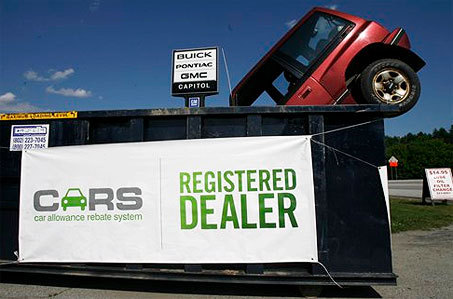
The program was designed to encourage owners of pollution-spewing gas guzzlers to trade them in for NEW, more-efficient cars, helping the hard-pressed auto industry and the environment, too. Enticed by rebates of $3,500 to $4,500, car owners are jumping at the offer. It worked, almost too well.
Far more drivers signed up for the program, leaving dealers panicked over when or if the government would make good on the hefty rebates.
The House was first in what's expected to be a fast pit stop, voting to pour in another $2 billion. The Senate has yet to act -- it is expected to take up the measure next week -- but the White House said weekend deals would count, no matter what.
President Obama said the program has "succeeded well beyond our expectations" and is pushing the Senate to pass the measure next week.
But Republicans are questioning the government's readiness for wading deep into other private-sector strongholds, such as health care.
The government can't reasonably calculate the response for an automobile trade in program, how can they calculate the response to a much more complicated program?
The government is now going to spend another 2 billion dollars on the CARS program. The government underestimated the cost of the program by two thirds! The idea behind the program is fairly simple. There are only two possible CARS benefits, $3,500, or $4,500 dollars. Compared to health care the CARS program is a walk in the park; there are only two figures to deal with. I wonder how much health care "reform" is really going to cost?
The stated purpose is to get people out of their inefficient vehicle, and into a NEW fuel efficient vehicle, while at the same time spurring auto sales. Here are the requirements to trade in:
http://www.cars.gov/faq#category-06
* have been manufactured less than 25 years before the date you trade it in
* have a "new" combined city/highway fuel economy of 18 miles per gallon or less
* be in drivable condition
* be continuously insured and registered to the same owner for the full year preceding the trade-in
* The trade-in vehicle must have been manufactured not earlier than 25 years before the date of trade in and, in the case of a category 3 vehicle, must also have been manufactured not later than model year 2001
The program introduces a number of unintended side effects. For instance, many of the people trading in older cars and trucks most likely have no car payments. There are not many vehicles manufactured within the past 5 or 6 years that have a combined EPA fuel efficiency rating of under 18 MPG. Sure, the owners of new more fuel efficient vehicles will save on fuel, but what about payments on a new car? People are going to be spending a lot more money with a new vehicle than they would with an older, paid for vehicle, regardless of the fuel efficiency. Insurance premium rates are higher on newer vehicles.
With the government making the down payment, new vehicle prices will remain artificially high. This current increase in auto sales does not reflect actual market forces.
Banks will have a much harder time selling repossessed cars. The CARS benefit DOES NOT apply to used cars.
There will be huge vacuum when the program expires. New car sales will drop.
http://www.foxnews.com/politics/2009/08/01/popularity-web-snafus-nearly-broke-clunkers/
The backlog had been building for weeks. Auto dealers could begin offering the rebate at the beginning of the month, and many began doing so over the July 4 weekend. But it was not until a week ago that dealers could begin filing for reimbursement, leaving them on the hook for as much as $4,500 per car until they get the federal money.
That's when they ran into difficulties with a federal Web site ill equipped to handle the volume of claims and the multiple documents each submission requires. Some dealers said the process took upward of an hour for each transaction, caused repeated rejections and consumed many hours submitting and resubmitting data.
At Walser Toyota in Bloomington, customers began lining up on Monday before doors opened at 7:30 a.m.. Swenson said. By that afternoon, his dealership had done 150 trade-ins under the program. His salesmen worked overnight to scan and submit forms.
But of the 150, he said, only 30 received responses and all of those were rejections.
Dealers are now on the hook for more than 1 billion dollars, and there is literally no clear plan to reimburse them. It's not sure when and if the government will make good on the reimbursements; how long can the dealers hold out?
Government controlled health care doesn't sound so nice now, does it?
Note: You DO NOT need to register to leave a comment.
All this racism is killing me inside...
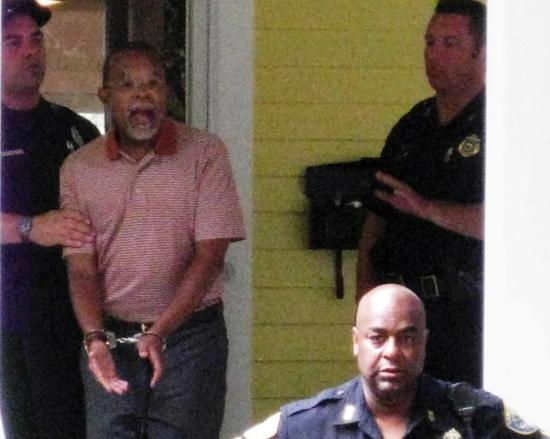
Henry Louis Gates, Jr. is arrested, it must be racially motivated right?
http://www.cnn.com/2009/US/07/23/officer.gates.arrest/index.html
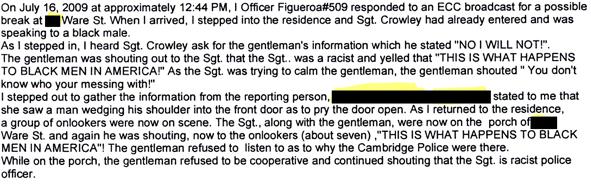
Before making your conclusion, you should probably read the police report.
PDF file of police report, downloaded from Foxnews.com Gates_Arrest

Let's imagine that the Henry Louis Gates, Jr. - instead of breaking into his own home - hired a locksmith. He would still be required to show the locksmith some form of ID, proving that the property was indeed his residency. Would Gates have reacted the same way if a locksmith asked him to show some ID?
Gates did NOT own the house he was staying in, he was renting it. Is it possible that Gates didn't call a locksmith, because the ID did not show the address to be his residence. After all the locksmith won't let you in if you have no proof that you belong in the residence.
Obama when asked about the incident with Gates, one of Obama's friends, gave this reply. Note that Obama's reply was at the end of a nationally televised news conference on health care reform.
"I think it's fair to say, No. 1, any of us would be pretty angry," Obama said. "No. 2, that the Cambridge police acted stupidly in arresting somebody when there was already proof that they were in their own home. And No. 3 — what I think we know separate and apart from this incident — is that there is a long history in this country of African-Americans and Latinos being stopped by law enforcement disproportionately, and that's just a fact."
Obama's quote shows that he was not well informed as to what had taken place, but had already prejudged the situation.
http://www.foxnews.com/story/0,2933,534615,00.html
NATICK, Mass. — The white police sergeant criticized by President Barack Obama for arresting black scholar Henry Louis Gates Jr. in his Massachusetts home is a police academy expert on understanding racial profiling.
Cambridge Sgt. James Crowley has taught a class about racial profiling for five years at the Lowell Police Academy after being hand-picked for the job by former police Commissioner Ronny Watson, who is black, said Academy Director Thomas Fleming."I have nothing but the highest respect for him as a police officer. He is very professional and he is a good role model for the young recruits in the police academy," Fleming told The Associated Press on Thursday.
The course, called "Racial Profiling," teaches about different cultures that officers could encounter in their community "and how you don't want to single people out because of their ethnic background or the culture they come from," Fleming said. The academy trains cadets for cities across the region.
Fellow officers, black and white, say Crowley is well-liked and respected on the force. Crowley was a campus police officer at Brandeis University in July 1993 when he administered CPR trying to save the life of former Boston Celtics player Reggie Lewis. Lewis, who was black, collapsed and died during an off-season workout.
- Tell me what you think...
Note: You DO NOT need to register to leave a comment.
Thoughts on health care; as a right…

Thoughts on health care; as a right…
If health care was a right, how would the government protect it? Remember it is the government’s job to PROTECT our rights, NOT provide them.
Our rights are endowed by our creator, NOT government.
It is the government's job to protect our rights.
If health care is a right, wouldn't the government protect the ability of individuals to pursue the health care of their choice? This would involve the government DEREGULATING, and allowing individuals to determine what is best.
If health care is a right, should the government be allowed to DENY health care to anyone? Health care rationing is happening in the U.K. right now. It is also happening in Canada. There is simply NOT enough wealth to secure the health of every citizen.
In order for the government to secure your health, there would need to be guidelines set. There would be limits placed on what sorts of foods you can eat, and when you can eat them. The government would have to take complete control of your diet, and your freedom as a result. After all you don’t want to hurt yourself, do you?
Many people look at health care as a right. Perhaps they can look a little past the hype, and see what is at stake here.
Note: You DO NOT need to register to leave a comment.
Health Care Reform, or systematic reduction of choice?
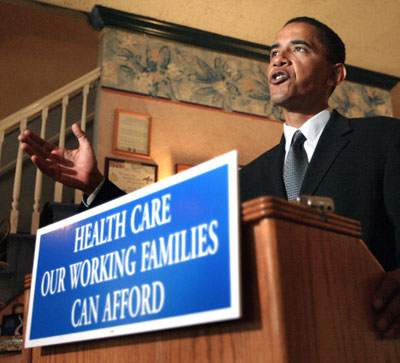
There are many key features that people MUST pay attention to when it comes to the most resent round of “Health Care Reform.” It seems that with any government program people need to be careful for what they wish for, they might just get exactly that.
If you go to page 16 of the Health Care Reform bill H.R. 3200 you will find this:
SEC. 102. PROTECTING THE CHOICE TO KEEP CURRENT COVERAGE.
(a) GRANDFATHERED HEALTH INSURANCE COVERAGE DEFINED.—
Subject to the succeeding provisions of this section, for purposes of establishing acceptable coverage under this division, the term “grandfathered health insurance coverage” means individual health insurance coverage that is offered and in force and effect before the first day of Y1 if the following conditions are met:
(1) LIMITATION ON NEW ENROLLMENT.—
(A) IN GENERAL.—Except as provided in this paragraph, the individual health insurance issuer offering such coverage does not enroll any individual in such coverage if the first effective date of coverage is on or after the first day of Y1.
This means that you can keep the coverage you already have “grandfathered health insurance coverage”, so long as the policy was started before the year the bill becomes law. In and of itself, this doesn’t sound so bad. Then you read the next part.
Except as provided in this paragraph, the individual health insurance issuer offering such coverage does not enroll any individual in such coverage if the first effective date of coverage is on or after the first day of Y1.
This means that the insurance issuer (your insurance company) CAN NOT add any individual to the plan after the first day of the year the bill becomes law. There is a provision that will allow you to add dependents, but that’s it.
To sum this up, it means that your current private health insurance plan will become illegal. The existing insurance companies would be able to keep running, but only with the people that they already have in their current plans. Future plans would have to be based on government guidelines.
Once the bill becomes law if you switch employers or start your own business, you WILL NOT be able to purchase the same health insurance, as it will be illegal for insurers to issue new policies with the same attributes. The insurance policies with mandated government specified premiums and deductibles will be the only insurance options available.
This is like telling a grocery store chain that they cannot purchase any new inventory (it will be illegal), they just have to sell what they have currently in stock. Then claim that it is not illegal to own and operate a grocery store, you just can't purchase any new stock. How is the grocery store supposed to stay in business? When later allowed to purchase new inventory, that stock will be determined by the government. This is exactly how the H.R. 3200 proposes private health care insurance is supposed to function.
Up until now, I figured congress would regulate the private industry into failure. But here in this bill they make private insurance illegal. To make it all the more insulting this provision is under the section “PROTECTING THE CHOICE TO KEEP CURRENT COVERAGE.” All of this is right on page 16, take a look…
PDF file: H.R. 3200 downloaded from the Thomas.gov website
This is just the beginning though. Remember how Obama said that we have to reform health care because it's killing our economy? You should take a look at the report from the non partisan Congressional Budget Office report.
■ Currently, a significant share of the population moves in and out of insurance
coverage during a year, which complicates efforts to provide effective
prevention and wellness services. As discussed later, though, those services
are less broadly effective at reducing health care spending than might be
expected, and in any event, expansion proposals would not eliminate all of the
churning that makes it harder to maintain continuity of care.■ Most expansions of insurance coverage that are under consideration would
leave a moderate number of people uninsured, in part because some people
would be ineligible for subsidies or would choose not to buy insurance even
with large subsidies. Therefore, any current problems arising from the lack of
insurance could be reduced but not eliminated.It also bears emphasizing that if a reform package achieved “budget neutrality”
during its first 10 years, budgetary savings in the long run would not be
guaranteed—even if the package included initial steps toward transforming the
delivery and financing of health care that would gain momentum over time.
Different reform plans would have different effects, of course, but two general
phenomena could make the long-run budgetary impact less favorable than the
short-run impact:■ First, an expansion of insurance coverage would be phased in over time to
allow for the creation of new administrative structures such as insurance
exchanges. As a result, the cost of an expansion during the 2010–2019 period
could be a poor indicator of its ultimate cost.■ Second, savings generated by policy actions outside of the health care system
would probably not grow as fast as health care spending. Such would be the
case for revenues stemming from the Administration’s proposal to limit the
tax rate applied to itemized deductions and from proposals to tax sugar-sweetened
soda or alcohol, for example.Some policy options under consideration would yield savings that grew in tandem
with health care spending—reducing the level of federal spending on health care
but not affecting the measured rate of spending growth after the first few years.
For example, the largest savings proposed in the President’s budget would arise
from a decrease in payments to private health insurance plans operating under the
Medicare Advantage program. If enacted, that change would permanently lower
the level of Medicare spending, but it would probably not offset a noticeably
larger share of the cost of an expansion of insurance coverage in the second
10 years than in the first.
Here is a copy of the CBO report:
PDF file: 06-16-HealthReformAndFederalBudget from the CBO website
There is nothing in the proposed bill that would significantly decrease the number of uninsured, or save money in the long run. What, then, is the purpose of this bill?
Note: You DO NOT need to register to leave a comment.
"Health Care" or "Health Force" ?
http://www.foxnews.com/politics/2009/07/13/obama-wants-health-reform-week/
Despite objections from conservative and moderate Democrats, prospects for House action along the president's timetable are better than in the Senate.
There, majority Democrats are readying legislation, to be introduced as early as Tuesday, that would prohibit insurance companies from denying coverage or charging higher premiums on the basis of pre-existing medical conditions.
The measure would spend billions of dollars subsidizing lower income individuals and families who cannot afford coverage, in an attempt to cut dramatically into the ranks of the uninsured.
To comply with another presidential priority, it would rely on cuts in Medicare and Medicaid to begin slowing the rate of growth in health care spending overall.
The measure is expected to impose a fee equal to 8 percent of a worker's salary on large companies that fail to offer insurance or do not subsidize it at a high enough rate.Individuals also would have to pay a penalty if they refused to purchase affordable insurance.
Officials announced last week that the measure would include an income tax surcharge on the wealthy, estimated to raise more than $500 billion over the next decade.
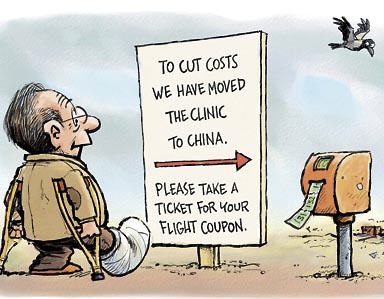
I thought that the government was going to provide competition for private insurance companies? What is this about imposing regulations which will drive up health insurance premiums? Remember Obama said that he is open to the idea of taxing health insurance premiums.
There, majority Democrats are readying legislation, to be introduced as early as Tuesday, that would prohibit insurance companies from denying coverage or charging higher premiums on the basis of pre-existing medical conditions.
The devil is in the details. The legislation states that it will prohibit denying coverage or charging higher premiums on the basis of pre-existing medical conditions. This means that people WITHOUT pre-existing medical conditions will be susceptible to premium increases. Which means that premiums will go up. Rates will have to go up once the insurance companies are FORCED to insure people with such high risk factors. Remember, auto insurance companies and property insurance companies can refuse to insure based on risk assessments. This isn't because they are greedy, this is because they are a business, in business to make money, not loose it.
Consider this; you insure your house and then purposely burn it down the next day. This would be considered insurance fraud. You would go to jail for burning your own house down to collect money. The government is forcing insurance companies to insure human beings without assessing the possibility that the insured may never contribute towards the policy premium. The insurance company must ignore all risk factors. How is this going to help make health care more affordable?
How is imposing cuts in Medicare, and Medicaid supposed to slow the rate of growth in health care spending? Did the "stimulus bill" not have 460 BILLION dollars allocated for health care? Remember as Obama said the 460 Billion is just a start. These "cuts" are complete nonsense.
The government is going to impose a fine on individuals if they refuse to purchase "affordable" insurance. How exactly do you define "affordable"? How do you determine what is affordable for each and every individual?
Did any democrat voter think that they were going to pay a penalty for NOT buying insurance?
Note: You DO NOT need to register to leave a comment.
 XML Feeds